
How to price your work: start from what you want to keep
Most people price forward, from materials and hours, then find out at payout what the fees left them. The arithmetic is easier in reverse. Here is the formula, the three numbers you need before you use it, and what it does to the price of a heavy parcel.
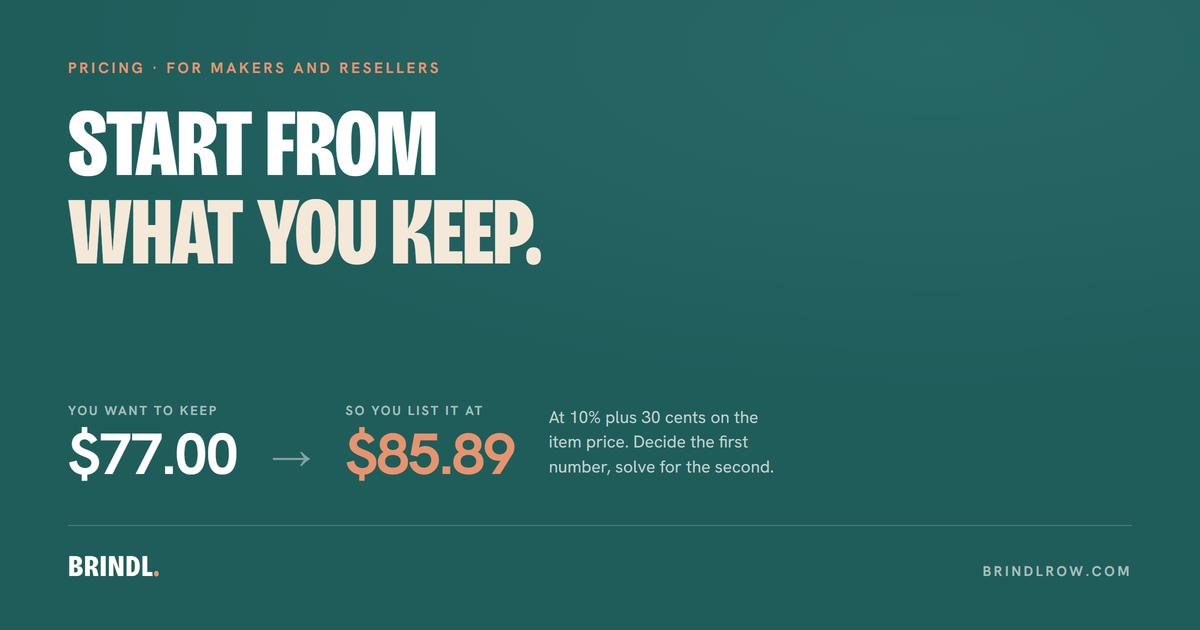
There are two ways to arrive at a price. You can add up what the thing cost you, add something for your time, and post it. Or you can decide what you want to be left holding when the money lands, and work backwards to the number on the listing.
Almost everyone does the first one. The fees then come off the end, quietly, and the amount that reaches your bank is a surprise rather than a decision. The second way takes one line of arithmetic.
This is about things you make or resell. If you sell your time instead, the part of pricing that is judgement rather than arithmetic is in pricing a service job so you actually get booked, and the formula below still applies to the fee.
The three numbers you need first
No formula helps until you have an honest figure for what the item costs you to make and send.
- Materials, including what you wasted. If you cut four boards and one splits, the cost of the split one belongs to the three that sold.
- Your time, at a rate you would accept from someone else. Not a rate you would be embarrassed to say out loud. Count the hour nobody counts: photographs, writing the listing, answering questions, packing, and the trip to the post office.
- Overhead per item. Box, tape, label, and a share of the tools and the bench. A rough per-item number is fine as long as it is not zero.
Add them up. That total is what you want to keep. Say it comes to $77: $18 of material, two and a half hours at $22, and $4 of packaging and wear.
The formula
Marketplace fees nearly all have the same shape: a percentage of the sale, sometimes plus a fixed amount per order. Call the percentage r and the fixed part F. To end up with the amount you want to keep, list at:
list price = (what you want to keep + F) divided by (1 minus r)
That is the whole thing. Note what it is not: you cannot simply add the fee to your price, because the fee is then charged on the bigger number you just created, and one pass leaves you short.
On a real sale
Brindl's fee is 10% plus 30 cents on the item price, so r is 0.10 and F is 0.30.
- ($77.00 + $0.30) divided by 0.90 = $85.89
- Round up to $86. The fee on that is $8.60 plus $0.30, so $8.90.
- $86.00 less $8.90 leaves $77.10 for you.
Priced forward, you would probably have posted the same board at $77 and kept $69.00. You would be $8 short of the number you decided on, on every one you sell, to a fee you already knew the size of.
What to plug in elsewhere
The same line works on any platform once you know its two numbers. The published US structures for a few:
- Brindl: r = 10%, F = $0.30, on the item price only.
- Etsy: 6.5% plus payment processing of 3% and 25 cents, so r = 9.5% and F = $0.25, charged on the item and the shipping. Add 20 cents to list, again every four months it sits unsold. If an Offsite Ad gets credit for the sale, another 15% comes off the order, 12% once you pass $10,000 a year, and above that you cannot opt out.
- Mercari: r = 10%, no fixed part, charged on the item and the buyer-paid shipping.
- Poshmark: r = 20% above $15, or a flat $2.95 at $15 and under. Shipping is a flat label the buyer pays.
- Fiverr: r = 20% of the order, tips included.
- eBay: the rate depends on the category, and the fee applies to shipping too. There is a calculator for it on our page for eBay sellers.
Shipping is where the formula bites
When a platform charges its percentage on the shipping your buyer paid, the label is part of what you are being charged for, so the item price has to carry that as well:
list price = (what you want to keep + F + r times the shipping) divided by (1 minus r)
Same $77, same 10%, but on Mercari, where the 10% covers shipping, with a $12 label:
- ($77.00 + $1.20) divided by 0.90 = $86.89, against $85.89 for the same take-home where shipping is left alone.
A dollar on one sale. It scales with the parcel, though, because what you are really doing is setting aside part of the item price to pay a percentage on a label. On a $30 label it is $3.33 of the item price, before anything has been sold.
There is a second number worth a look while you are in here, which is what the buyer sees. Mercari adds a 3.6% buyer protection fee on the item and the shipping, so your $86.89 listing costs them $102.45 at checkout. The $85.89 version with the same $12 label comes to $97.89. Same $77 for you either way, and $4.56 less asked of the person deciding whether to buy it.
When the number comes out too high
Sometimes the formula returns a price the item cannot sell for. That is information, not an error to overwrite. The honest responses, roughly in order:
- Take time out of the build. A jig, a template, a batch of six instead of one. This is the only lever that raises your hourly pay without touching the price.
- Change the materials, and say so in the listing.
- Make something else. If a thing takes four hours and the market pays for two, it is a gift rather than a product. Some things are worth making anyway. It helps to know which ones.
What not to do is quietly lower your own rate until the arithmetic agrees with the price. The number did not change. You stopped writing it down.
Leave yourself the offer
If you take offers, the price the formula gives you is the floor, not the listing. List above it by however much you are willing to come down, and set the floor as your minimum. On Brindl that is per listing: you switch offers on when you post, and you can set the lowest offer you want to see, so anything under your floor never reaches you.
Our own numbers
We run Brindl, so read this as interested rather than neutral. The figures above are what the site actually charges, and the pricing page shows the arithmetic at several prices.
The part that matters to the formula is small. The fee is 10% plus 30 cents, on the item price, and nothing comes off shipping: the buyer pays the live carrier rate to their own address and it goes to the label. Listing is free with nothing to renew, so an item that does not sell has not cost you anything. Your cut releases 3 days after the sale, to your bank through Stripe, with nothing charged to withdraw it. A cash, in person sale costs nothing at all, which makes the formula very short: r and F are both zero, and the price is the price.
If you would rather run your own figures against the platform you sell on now, the comparison page has a calculator for each one.