
eBay's October 1 shipping change, and what it actually costs you
eBay is about to start showing buyers your discounted label rate instead of the retail carrier rate. Here's the arithmetic on what that does to your margin per order, and why sellers are annoyed about something billed as good news.
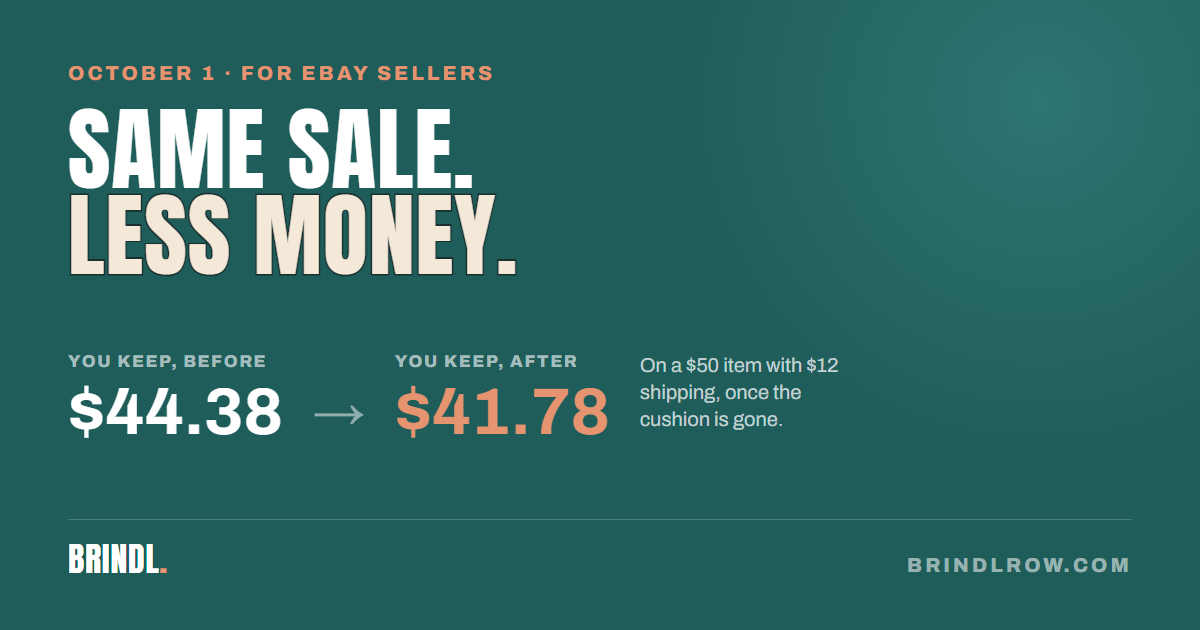
If you sell on eBay with calculated shipping, you probably got an email in the last few days with the subject line "Good news." Plenty of sellers did not read it that way. Here is what is actually changing, and the arithmetic behind the reaction.
What changes
Starting October 1, listings that use calculated shipping will show buyers the discounted eBay Labels rate rather than the retail carrier rate. Flat-rate and free-shipping listings are not affected. Sellers who received the email were opted in automatically, with a September 25 deadline to opt out.
On its own, a lower shipping price for buyers is a reasonable thing to want. Cheaper shipping means better conversion, and nobody enjoys watching a sale die at the shipping line.
Why sellers are annoyed anyway
The problem is not the discount. It is that eBay's final value fee is charged on the whole order, shipping included.
Today there is a gap between what the buyer pays for shipping (the retail rate) and what you actually pay for the label (the discounted rate). That gap is not really profit. It is the cushion that absorbs the fee eBay charges on the shipping portion of the order. Show the buyer the discounted rate and the cushion disappears, but the fee on shipping does not.
The math, on one order
Take a $50 item, a $12 retail shipping rate, a $9 label, and a 13.25% final value fee plus $0.40 per order.
Before October 1:
- Buyer pays $50 + $12 = $62
- eBay's fee: 13.25% of $62, plus $0.40 = $8.62
- You buy the label: $9.00
- You keep $44.38
After October 1:
- Buyer pays $50 + $9 = $59
- eBay's fee: 13.25% of $59, plus $0.40 = $8.22
- You buy the label: $9.00
- You keep $41.78
That is $2.60 less on the same sale. Your fee did go down by 40 cents, because the order total is smaller. But you gave up the entire $3.00 shipping cushion to get it.
Scale that across a month and it adds up quickly. Twenty orders a month at that shape is around $52. The bigger and heavier what you sell, the worse it gets, because shipping is a larger slice of the order.
What you can do about it
- Opt out if it is before September 25 and the math does not work for you. The link is in the email eBay sent. After October 1 you can still change your carrier rate settings in your shipping preferences.
- Reprice. If you stay opted in, the shipping cushion is gone, so the item price has to carry the fee instead. Roughly, add what you were clearing on shipping to the item price.
- Reconsider flat rate for items where you can predict the cost. This change only touches calculated shipping.
- Cross-list. Nothing stops the same item sitting on more than one site.
Where we come into this
We will be upfront: we run Brindl, so we are not a neutral party. But this change is a good moment to point out that charging a fee on shipping is a choice, not a law of physics.
Brindl's fee is 10% plus 30 cents, and it is charged on the item price only. Shipping is the real carrier rate, passed straight through to the label. We take nothing from it, which means there is no cushion to lose in the first place. On that same $50 item, a seller keeps $44.70.
We are also much smaller than eBay, and it would be silly to pretend otherwise. We are not suggesting you close your eBay store. Cross-listing costs nothing here, though: listing is free, and the fee only applies when something actually sells.
If you want to run your own numbers, there is a calculator on our page for eBay sellers where you can put in your own item price, shipping rate, label cost, and category fee.